The Five Element Strategy
In a recent conversation, I was asked to propose a simple framework for designing a clear, effective and actionable strategy that can be adopted and embraced by the leadership and well as rank and file of an organization!
In future articles, I will discuss each of these 5 elements in details. For example, we will discuss how to set your organization’s goals, define the pillars, etc..
1- Set the goal(s): A clear, concise and well-defined goal statement is the first element of any strategy. Using AI as an example; a crisp goal statement could read:
- To power {my company’s} products and services to become a healthcare AI ‘Top Quadrant’ leader by 2026

2- Construct the pillars (upon which the strategy will be built):
The pillars are the guiding posts that all Tracks and Activities will follow. For example, pillars could be:
- Reimagine current assets
- Product Innovation
- Restructure for agility
3- Build the tracks (which are the roads to deliver for the pillars)
Having defined the pillars, now it is time to define which tracks will be created to enable to strategy.
These tracks are broad umbrella under which the Activities for each track will fall.
Examples of tracks are:
- Organization, execution and delivery
- Customer value proposition
- AI innovation
- Agility
4- Articulate the objectives for each track:
For each of the tracks, you need to define one or more objectives (less than 5 to avoid ‘catch all’ ambiguity and dilution of objectives’ focus). As an example, for the AI innovation track, you could state as an objective:
- Develop 3 cutting-edge innovative AI powered products each quarter, at least 1 of the three should be commercially successful are define by product development and sales teams
5- Describe key activities for each objective: In order to make your objective statement a reality, you must now define the Operational activities that will deliver on the defined objectives. These are product and project-based set of activities that will be used to carry out the specific actions needed to achieve your strategy goals. For example:
- Define 6 candidate use cases for cutting-edge AI applications
- Identify the methods, tools, techniques, and skills needed to achieve a certain objective
- Re-structure for alignment, efficacity and agility
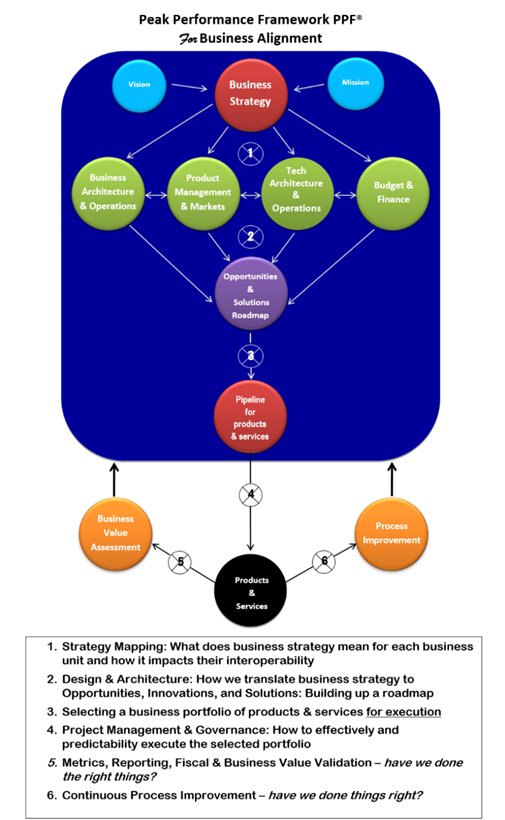
Once you define these activities, and to ensure excellence in execution and delivery, as well as validating alignment with strategy, you may want to use a framework such as the Peak Performance Framework for business alignment. This framework will also be the subject of a future discussion.